November 3, 2026
How Jiu-Jitsu Helps Children Succeed in School: The Science Behind Focus, Discipline, and Academic Performance
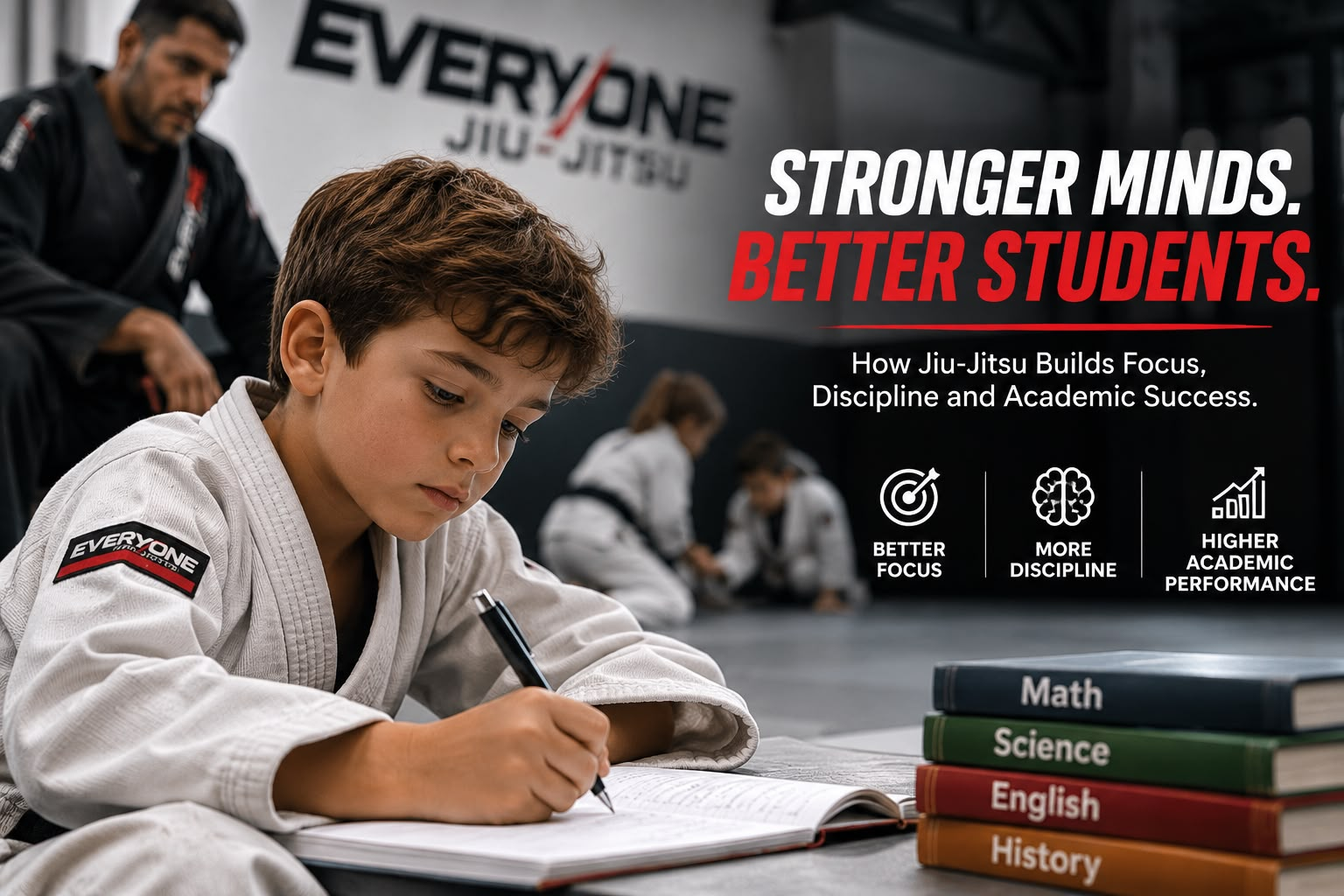
At Everyone Jiu-Jitsu, we believe that the lessons children learn on the mats extend far beyond the academy. They can influence how children think, learn, behave, and perform in the classroom.
Parents often enroll their children in Brazilian Jiu-Jitsu to help them become more confident, learn self-defense, improve coordination, or develop discipline.
But there is another important benefit that deserves more attention: the potential impact of martial arts training on children’s cognitive development and academic performance.
Research suggests that structured martial arts practice and regular physical activity can support attention, executive function, self-regulation, classroom behavior, and even academic achievement.
Let’s look at what science tells us.
Jiu-Jitsu and Improved Attention and Concentration
One of the most important skills a child needs to succeed in school is the ability to pay attention.
In Jiu-Jitsu, children constantly practice listening to instructions, observing demonstrations, remembering sequences, recognizing patterns, and responding to changing situations.
They must concentrate on what the instructor is teaching while controlling their own movements and interacting with a partner.
These activities challenge several cognitive processes, including:
- Sustained attention.
- Working memory.
- Mental flexibility.
- Problem-solving.
- Impulse control.
A 2025 study published in the Journal of Experimental Child Psychology investigated the effects of martial arts instruction on attention in 90 children aged 5-6.
The researchers found that children participating in a sensory-based martial arts program showed significant improvements in executive attention compared with children participating in regular free activities.
This is particularly interesting because attention and executive control are fundamental skills for classroom learning.
Better Executive Function Can Support Better Academic Performance
Executive function is a group of mental skills that help children organize information, manage their behavior, follow instructions, solve problems, and complete tasks.
Think about what a student needs to do during a typical school day:
- Listen to the teacher without getting distracted.
- Remember instructions.
- Complete assignments.
- Wait their turn.
- Control impulses.
- Stay focused when something becomes difficult.
These are all connected to executive function.
A 2021 study published in the International Journal of Environmental Research and Public Health, titled:
“Sports, Executive Functions and Academic Performance: A Comparison between Martial Arts, Team Sports, and Sedentary Children”
Researchers studied 102 children with an average age of approximately 12 years.
The study compared children participating in martial arts, team sports, and no organized sports.
The findings were particularly interesting:
Children practicing martial arts demonstrated better executive functioning and higher school marks than children participating in team sports or those who were not involved in organized sports.
Although this was a comparative study and cannot establish that martial arts directly caused higher grades, it provides encouraging evidence of a relationship between martial arts participation, cognitive performance, and academic achievement.
Better Behavior, Self-Control, and Emotional Regulation
Academic success is not just about intelligence.
A child also needs to manage frustration, respect boundaries, follow rules, and interact positively with teachers and classmates.
This is where martial arts can make a meaningful difference.
In Jiu-Jitsu, children learn that:
- They must listen before acting.
- They must respect instructors and training partners.
- They must control their emotions when things do not go their way.
- They must accept corrections and learn from mistakes.
- They must understand that progress requires patience and consistency.
These lessons are reinforced during every class.
A particularly relevant study was published in Developmental Psychology in 2022.
Researchers Terry Ng-Knight and colleagues conducted a randomized field experiment involving 240 children between the ages of 7 and 11 in the United Kingdom.
The children participated in an 11-week introductory Taekwondo program.
Following the intervention, teachers reported that children in the martial arts group demonstrated:
- Better attentional control.
- Fewer symptoms of behavioral problems.
- Improvements in executive attention.
The researchers also found improvements in children’s willingness and motivation to use self-regulation skills.
This is important because the ability to control one’s behavior is essential not only in martial arts but also in the classroom, at home, and in everyday social situations.
Can Physical Activity Improve Children’s Grades?
The relationship between physical activity and academic performance has also been investigated extensively.
A 2025 systematic review and meta-analysis published in Frontiers in Public Health examined 17 studies involving school-based physical activity programs for children and adolescents.
The researchers found statistically significant improvements in overall academic achievement and mathematics performance among children participating in physical activity programs.
This supports an important idea: physical activity is not necessarily competing with academic development. It can complement it.
Children need opportunities to move, challenge themselves physically, and engage in activities that stimulate both their bodies and minds.
Jiu-Jitsu provides an environment where physical movement is combined with learning, memory, decision-making, and problem-solving.
Why Jiu-Jitsu Is Different: Learning Through Movement and Problem-Solving
Unlike activities where children simply repeat the same movements, Brazilian Jiu-Jitsu involves constant problem-solving.
Every training session presents new situations.
A child must understand positioning, recognize opportunities, make decisions, adapt to a partner’s movements, and find solutions.
This creates a learning environment that combines physical, mental, and social challenges.
For example:
During a Jiu-Jitsu class, a child practices:
- Listening and following instructions.
- Remembering techniques and sequences.
- Making decisions under pressure.
- Controlling impulses.
- Respecting rules and personal boundaries.
- Accepting failure and trying again.
- Working cooperatively with others.
These experiences reinforce skills that are useful in school and everyday life.
Confidence, Persistence, and the Ability to Overcome Challenges
Another important connection between Jiu-Jitsu and school performance is confidence.
Children who believe they can improve through effort are more likely to approach challenges with persistence.
In Jiu-Jitsu, progress does not happen overnight.
A technique may take several weeks to understand. A movement may require dozens of repetitions. A child may struggle with something today and finally succeed next month.
Through this process, children learn an important lesson:
Failure is not the opposite of success. It is part of the learning process.
This mindset can translate into schoolwork.
Instead of giving up when mathematics becomes difficult or becoming frustrated with a challenging assignment, children can learn to approach problems with patience, persistence, and a willingness to improve.
The Importance of Consistency
The benefits of martial arts training are not built in one class.
They develop through consistent participation, repetition, guidance, and positive reinforcement.
At Everyone Jiu-Jitsu, we believe that the academy and the family should work together to help children develop healthy habits.
Our goal is not simply to teach children how to perform techniques.
We want them to develop:
- Discipline.
- Respect.
- Focus.
- Confidence.
- Responsibility.
- Self-control.
- Perseverance.
These qualities matter on the mats, in the classroom, and throughout life.
Final Thoughts: Building Better Students Through Jiu-Jitsu
As parents, we naturally want our children to succeed academically, socially, and emotionally.
We invest in their education because we understand that learning is essential to their future.
But development does not happen only inside a classroom.
Children also learn through movement, challenges, relationships, discipline, and real-life experiences.
Scientific research provides encouraging evidence that martial arts training and regular physical activity can support cognitive development, attention, behavioral regulation, and academic achievement.
While no sport can guarantee better grades, Jiu-Jitsu offers children an opportunity to develop many of the skills that help them become more effective learners.
At Everyone Jiu-Jitsu, our mission goes beyond teaching martial arts.
We want to help children become stronger, more confident, more disciplined, and better prepared for the challenges they will face in life.
Better focus. Better discipline. Better habits. Stronger kids.
Because the most important victories don’t always happen on the mats.
Sometimes, they happen in the classroom.
Scientific References
- 1. Li, B., et al. (2025). The influence of Chinese martial arts teaching intervention based on embodied cognition theory on attention networks in 5-6-year-old children. Journal of Experimental Child Psychology. DOI: 10.1016/j.jecp.2025.106316.
- 2. Giordano, G., Gómez-López, M., & Alesi, M. (2021). Sports, Executive Functions and Academic Performance: A Comparison between Martial Arts, Team Sports, and Sedentary Children. International Journal of Environmental Research and Public Health, 18(22), 11745. DOI: 10.3390/ijerph182211745.
- 3. Ng-Knight, T., et al. (2022). Does Taekwondo improve children’s self-regulation? If so, how? A randomized field experiment. Developmental Psychology, 58(3), 522-534. DOI: 10.1037/dev0001307.
- 4. He, H., et al. (2025). Effects of school-based physical activity on academic achievement in children and adolescents: a systematic review and meta-analysis. Frontiers in Public Health. DOI: 10.3389/fpubh.2025.1651883.